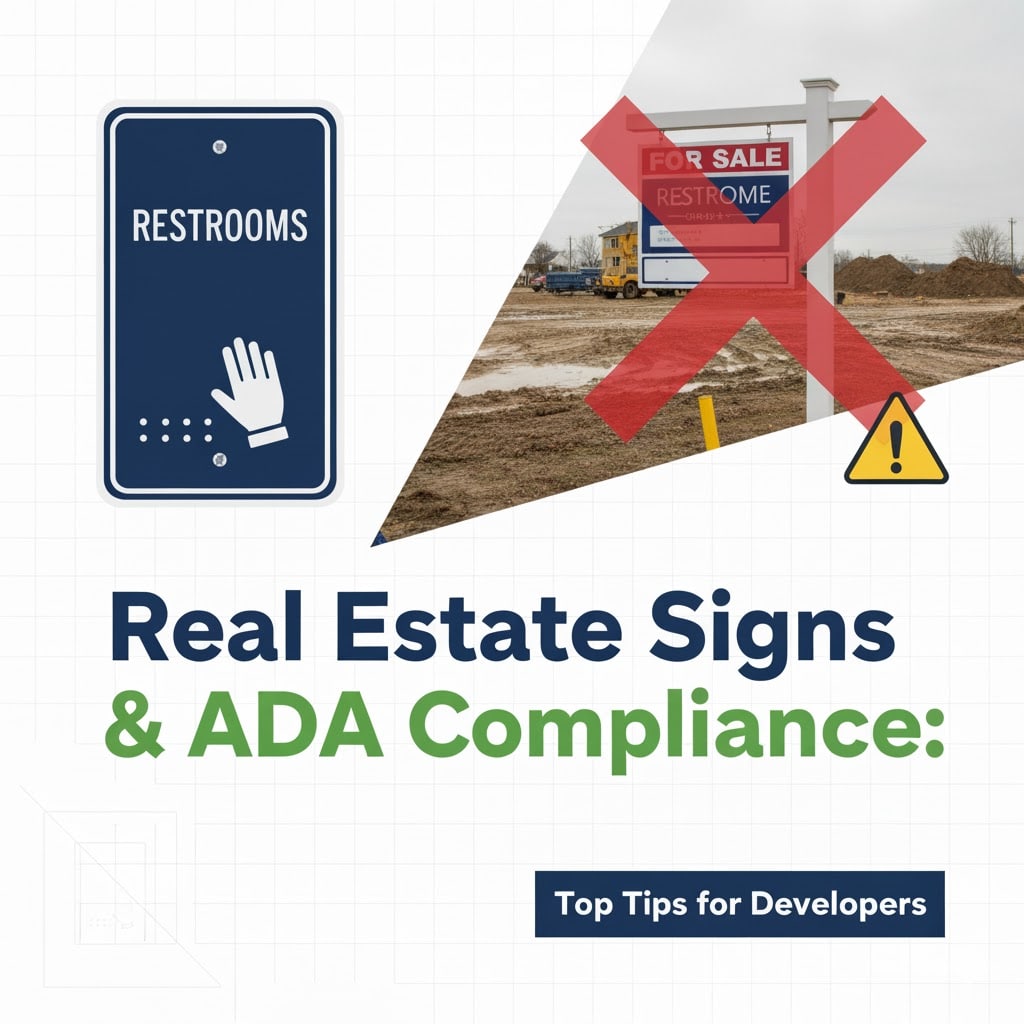
For Connecticut developers, launching a new project involves complex logistics. This includes zoning, construction, and sales. One critical area often becomes an oversight liability: permanent signage and the Americans with Disabilities Act (ADA).
Your Real Estate Signs drive traffic. They include eye-catching post-and-panel markers and vinyl banners. However, when customers enter your finished development, different rules apply.
ADA compliance covers more than ramps and parking. It sets strict standards for interior and exterior signage. This signage identifies rooms and common areas and provides wayfinding. Failing to plan for this creates liability. It can cause costly replacements and construction delays.
This guide helps Connecticut developers navigate the intersection of commercial Real Estate Signs and mandatory ADA compliance.
What is an “Element of the Facility”?
Developers must distinguish between temporary and permanent signs. Your short-term, promotional Real Estate Signs are usually exempt. Think of temporary flags or agent contact boards.
However, any sign meant to stay after the development is complete is “an element of the facility.” These signs must comply. Examples include:
Wayfinding: Signs directing visitors to the leasing office, pool, or fitness center.
Identification: Signs labeling specific rooms, units (apartments, condos), restrooms, and permanent storage areas.
Safety/Egress: Signs related to exit routes and stairwells.
Key ADA Signage Requirements
Compliance is highly technical. Standards are strict and unforgiving. Key standards that must be met include:
Tactile and Braille: All identification and directional signs must have raised (tactile) characters. They need corresponding Grade 2 Braille. These elements must be positioned exactly 48 to 60 inches above the floor.
Visual Elements: Fonts must be easily readable. Use non-decorative, non-italic styles. Character height, spacing, and stroke width are heavily regulated.
Color Contrast: A specific minimum contrast ratio is needed. This applies between the sign’s background and the text.
Mounting Location: Signs identifying permanent rooms must be mounted on the wall. Place them adjacent to the door’s latch side. Rules cover clear floor space in front of the sign.
3. State and Local Overlap in Connecticut
Federal ADA sets the baseline. However, your project must also satisfy state and local building codes. Connecticut is complex. A sign that meets federal ADA requirements may still violate a local zoning ordinance.
Work with a local sign company. They must be familiar with CT building codes. They also need to understand local town permitting. This is non-negotiable for success.
Where Real Estate Signs and ADA Present Risk
Developers often fail at the transition point. This occurs between the sales phase and the occupancy phase.
Model Home and Sales Office: Signs may be exempt if the sales office is in a temporary structure. If the office is in a permanent unit, all signs must be compliant immediately. This includes restrooms, exits, and temporary designation signs.
New Development Wayfinding: Developers often focus on the main real estate signs. These lead to the property. They frequently overlook the dozens of interior and exterior wayfinding signs required later. Signs for the clubhouse, leasing office, and public restrooms must be ADA-compliant on day one of public access.
Non-compliance risks are severe. Fines can reach five figures for the initial violation. Lawsuits can follow. This mandates full sign replacement and causes major budget overruns.
Your Local Compliance Partner: Archer Signs
Navigating this complexity requires a full-service, local partner. You need more than an online sign printer.
Archer Signs is an established, 5-star-rated custom sign provider. We serve all of Connecticut. We specialize in the complete signage program developers require.
Concept-to-Completion Compliance
We bridge the gap between your brand’s vision and legal requirements. Archer Signs manages the entire process:
Initial consultation to survey your site plan.
Custom design for brand consistency and ADA compliance.
Efficient manufacturing using durable materials.
Precision installation adhering to all mounting standards.
We guarantee two key things:
Your large, roadside marketing Real Estate Signs are impactful and permitted.
Your permanent identification and wayfinding signage is 100% ADA compliant.
Partner with us. You gain peace of mind. You work with a local company. We understand the specific demands of Connecticut permitting and building codes. We ensure your development meets both your marketing goals and your legal obligations.
Next Steps for a Compliant Development
Don’t treat ADA signage as a final punch-list item. Plan for it early. Integrate it into your initial design phase.
Proper signage is a legal shield. It is also a sign of a professional, accessible, and high-quality development. This enhances your property’s value and reputation.
Your development deserves a seamless, compliant, and professional sign program.
Avoid Risk and Delays
Partner with local experts who know Connecticut codes.
Request a Free Site Evaluation and ADA Signage Consultation with the experts at Archer Signs today. We will analyze your site plans. We ensure every sign is perfect, from the main Real Estate Signs to the smallest marker.
Call 203-882-8484 or visit our website to Request a Quote.